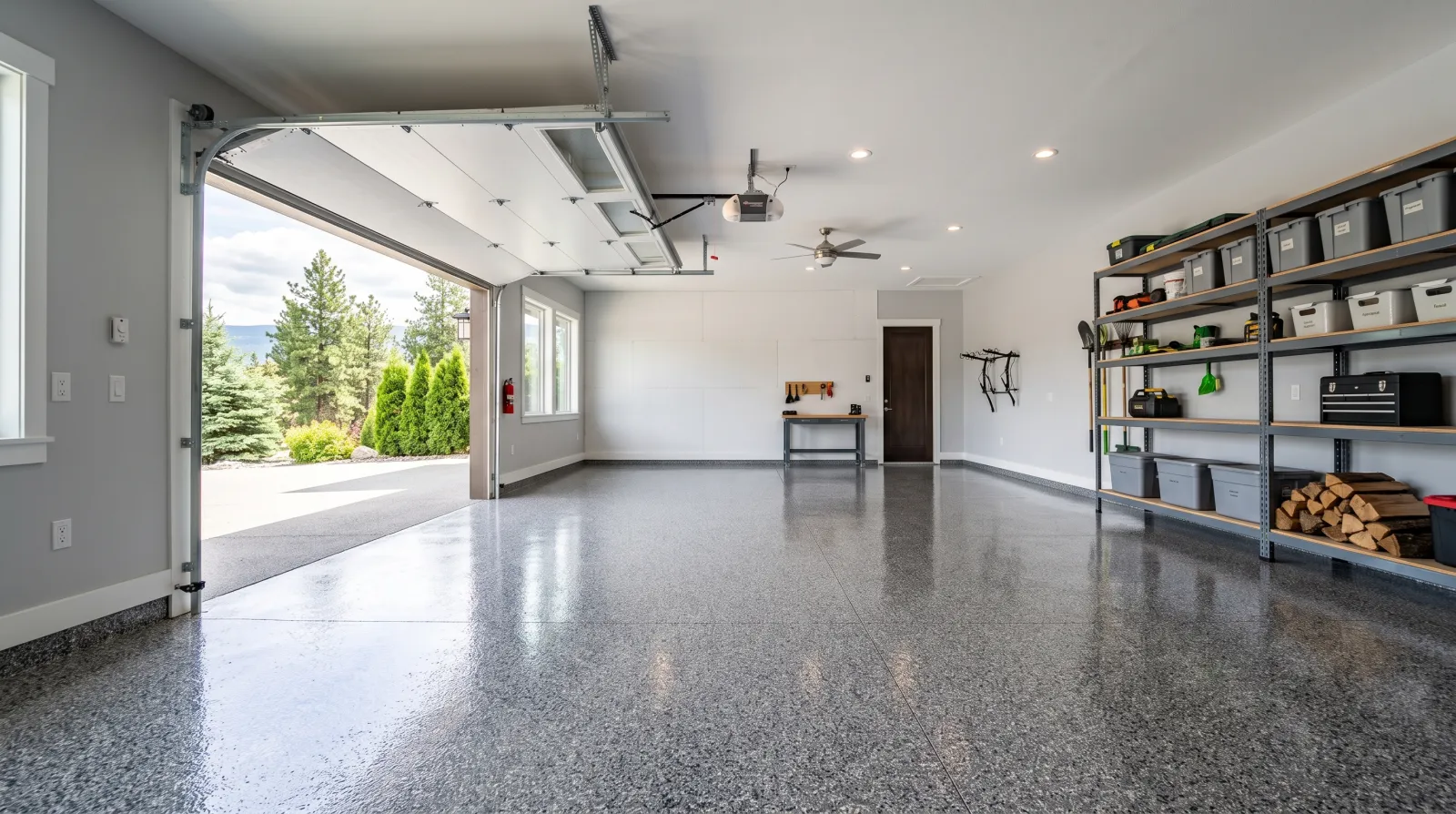
Okanagan Floor Coating Guide
Epoxy vs. Polyaspartic Floor Coating: Which Is Right for Your Garage?
By Mike Romer, Owner · OKGN Concrete Sealing · Updated July 2026
Quick Answer
Pick polyaspartic if you need the garage back fast (walk-on same day, drive-on in about 24 hours), your floor gets sun through the door, or the install has to happen in a cold month — it's UV-stable, more flexible, and tolerates a wider temperature range, but it typically runs more. Pick epoxy if budget leads and you can spare the floor for several days — it builds thicker per coat, cures very hard, and has decades of proven service behind it, though it can yellow in UV and cures slowly. For many garages the best answer is the hybrid: an epoxy base for build, a polyaspartic topcoat for speed and UV stability. Both are good floors — the right one depends on your timeline, sun exposure, and budget.
The Real Choice
Two Good Coatings, Two Different Strengths
If you've been researching a garage floor, you've run into the epoxy-versus-polyaspartic debate — and probably a lot of marketing that paints one of them as junk. It isn't. Epoxy has decades of proven service in garages, shops, and warehouses. Polyaspartic floor coating is the newer chemistry that fixed epoxy's two big complaints: slow cure and UV yellowing. Both make excellent floors when they're installed properly.
The short version: epoxy builds thick and hard on a budget; polyaspartic cures fast, shrugs off sun, and installs in a wider temperature window. And you don't always have to choose — the hybrid system (epoxy base coat, polyaspartic topcoat) is one of the most common professional builds for exactly that reason.
One point of housekeeping before we dig in: a floor coating is a different job from concrete sealing. Our penetrating Pavix sealer protects driveways and patios invisibly, with no film on top. A coating is the opposite — a visible, decorative, protective layer you walk and park on. We do both, but this guide is about coatings. Every system we install — epoxy, polyaspartic, or hybrid, in full-flake, metallic, or solid-colour finishes — goes down over diamond-ground concrete, residential or commercial, with no job minimum.
Side By Side
Epoxy vs. Polyaspartic, Line by Line
Speed and sun are polyaspartic's wins. Build thickness and budget are epoxy's. Here's the full line-by-line on what actually separates the two chemistries in a real Okanagan garage. Cure times shown are industry-typical — we confirm the numbers for your specific system in writing on your quote.
| Epoxy | Polyaspartic | |
|---|---|---|
| How it's applied | Two-part resin rolled over diamond-ground concrete, typically in multiple coats over multiple days | Two-part resin rolled over diamond-ground concrete — fast-setting, so full systems can go down in one day |
| Cure / return to service | Walk-on ~12–24 hours, drive-on ~3–7 days | Walk-on same day, drive-on ~24 hours |
| UV stability | Not UV-stable — can yellow or amber with sun exposure | UV-stable — holds colour and gloss in sunlight |
| Flexibility / impact | Very hard and rigid — strong, but rigidity can mean chips under sharp impacts | Slightly flexible — absorbs impacts and slab movement better |
| Thickness per coat | Thicker build per coat — good at filling minor surface texture | Thinner per coat — relies on multiple fast layers |
| Install temperature window | Narrow — wants warm, controlled conditions to cure properly | Wide — installs reliably in cold and shoulder-season conditions |
| Relative cost | More budget-friendly | Typically runs more than epoxy |
| Best for | Budget-led projects in closed, heated garages with a flexible timeline | Fast turnarounds, sun-exposed floors, cold-season installs |
Neither column is the "wrong" answer — and the hybrid system below borrows the best line from each. Whichever way you lean, the prep underneath matters more than the chemistry on top: every system we install starts with diamond grinding, not acid-etching. Curious what a full job involves before you get quotes? Our cost guide covers ballpark ranges for coating and sealing work.
In Detail
What You're Actually Getting With Each
Same finished look — flake, metallic, or solid colour — but two different chemistries getting you there. Here's what each one really does on the floor, and where each one earns its keep.

The Proven Workhorse
Epoxy Floor Coating
A two-part resin that cures into a very hard, very rigid film. It builds thicker per coat than polyaspartic, which helps it fill minor surface texture and carry a heavy flake broadcast, and it's been doing exactly this job in garages and shops for decades. Its trade-offs are honest ones: it cures slowly — plan on the industry-typical 3 to 7 days before parking on it — and standard epoxy will yellow with enough UV exposure.
- Thicker build per coat — a solid, hard-wearing foundation
- More budget-friendly than polyaspartic
- Decades of proven service in garages and shops
- Cures very hard — great under benches, hoists, and toolboxes
- Trade-offs: slow cure (drive-on ~3–7 days) and can yellow in UV
Where epoxy makes the most sense: a closed, heated garage where the sun rarely reaches the floor, a flexible timeline, and a budget you'd rather put toward flake and finish than cure speed.
The Fast, Sun-Proof Pick
Polyaspartic Floor Coating
A newer two-part chemistry built to fix epoxy's pain points. It sets fast enough that a full system — grind, base, flake, topcoat — can go down in a single day, with walk-on the same evening and drive-on in about 24 hours (industry-typical; confirmed on your quote). It's UV-stable, so no yellowing, and it stays slightly flexible, which helps it absorb impacts and slab movement. It also installs across a much wider temperature range.
- One-day installs are realistic — drive-on in about 24 hours
- UV-stable — won't yellow in a sun-facing garage
- Slightly flexible — handles impacts and slab movement
- Wide install temperature window — cold-season friendly
- Strong resistance to hot-tire pickup
The trade-off is straightforward: polyaspartic typically runs more than epoxy, and each coat goes on thinner. You're paying for speed, sun-proofing, and schedule flexibility.
The Hybrid System: Epoxy Base, Polyaspartic Top
For a lot of garages, the honest recommendation is both. An epoxy base coat lays down the thick, budget-friendlier foundation and locks in the flake broadcast. A polyaspartic topcoat goes over it as the wear layer — the UV-stable, flexible, fast-curing surface that actually faces tires, sun, and dropped wrenches. You get most of polyaspartic's benefits where they matter most, at a friendlier number than a full polyaspartic build. It's one of the most common professional systems for a reason, and we install it alongside full-epoxy and full-polyaspartic options.
How to Choose
Which One Should You Pick?
Run your garage through these two lists. If you land with a foot in each column, that's the hybrid system talking.
Choose epoxy if…
- Budget is the leading factor and you want the most floor for it
- You can keep vehicles off the floor for several days while it cures
- The garage stays closed most of the day — little direct sun on the slab
- You're coating a shop, basement, or interior space with no UV exposure
- You want maximum build thickness under heavy benches and equipment
Choose polyaspartic if…
- You need to park on the floor again within a day or two
- Your garage door faces the sun or stays open a lot — no yellowing
- The install has to happen in fall, winter, or a cold snap
- Hot-tire pickup worries you — summer heat plus daily driving
- You'd rather pay more once for speed and UV stability
Not sure which column you're in? That's literally what the free assessment is for. We'll look at your slab, ask how you use the garage, and recommend epoxy, polyaspartic, or the hybrid honestly — including when the cheaper option is genuinely the right call. Start with our garage floor coating service page, or book a free on-site assessment. For ballpark ranges before we visit, see the cost guide.
Why the Climate Decides
What an Okanagan Garage Does to a Coating
Summer first: Okanagan heat pushes pavement — and the tires that just drove on it — to serious temperatures. Pull a hot tire onto a marginal coating and the heat can soften it enough for the tire to peel it right off the slab. That's hot-tire pickup, the single most common garage floor failure, and it's where properly installed polyaspartic and hybrid systems earn their reputation. UV matters too — a sun-facing door means real sunlight on the first metres of floor, which is exactly where standard epoxy yellows.
Winter swings the other way. Cars drag in road salt, grit, and slush that sit on the floor all season — a coated floor shrugs that off and rinses clean, where bare concrete absorbs it and dusts and deteriorates. Winter also squeezes the install calendar: epoxy wants warm, controlled conditions to cure, while polyaspartic's wide temperature window keeps cold-season installs realistic. If your project lands between October and March, that alone often settles the choice.

The same logic scales up. Shops, showrooms, and warehouses run the same epoxy-versus-polyaspartic decision with bigger stakes — downtime on a working floor costs real money, which is why fast-curing polyaspartic topcoats are popular on commercial jobs. If that's your building, our warehouse floor page covers the commercial side. Either way, there's no job minimum — a single residential garage gets the same diamond-ground prep as a fleet bay.
FAQ
Epoxy vs. Polyaspartic: Common Questions
01Is polyaspartic better than epoxy?
+
Not universally — it's better at specific things. Polyaspartic cures faster (a one-day install is realistic), it's UV-stable so it won't yellow in a sun-facing garage, it stays a bit flexible, and it can be installed across a wider temperature range. Epoxy answers back with a thicker build per coat, a very hard surface, and a friendlier budget. Plenty of garages are perfectly served by epoxy. The honest answer is that they're two good products with different strengths, which is why the hybrid system — epoxy base, polyaspartic topcoat — is so common.
02How long before I can park on a new floor coating?
+
Industry-typical numbers, which we confirm in writing on your quote: a polyaspartic floor is usually walk-on the same day and drive-on in about 24 hours. Epoxy takes longer — walk-on in roughly 12 to 24 hours and drive-on in about 3 to 7 days depending on the product and temperature. If keeping the car outside for most of a week is a dealbreaker, that cure-time gap is often the deciding factor all by itself.
03Does epoxy floor coating yellow?
+
It can, yes. Standard epoxy is not UV-stable, so with enough sunlight exposure it ambers or yellows over time. In a garage that stays closed most of the day it may take years to notice; in a garage with big windows, a sun-facing door that's open a lot, or on any exterior concrete, it shows up sooner. Polyaspartic is UV-stable and holds its colour. This is exactly why the hybrid approach puts polyaspartic on top — the UV-stable layer is the one facing the sun.
04Can you install a floor coating in winter?
+
With polyaspartic, usually yes. It tolerates a much wider installation temperature range than epoxy, which is a real advantage in the Okanagan shoulder seasons and winter. Epoxy is fussier — most products want a warmer, controlled slab temperature to cure properly, so cold-season epoxy installs need a heated space or have to wait. If your timeline lands in the colder months, polyaspartic (or a hybrid finished with polyaspartic) keeps the schedule realistic.
05What is a hybrid epoxy-polyaspartic system?
+
It's an epoxy base coat with a polyaspartic topcoat — a very common professional build, and often the best of both. The epoxy layer gives you a thick, hard, budget-friendlier foundation that carries the flake broadcast. The polyaspartic layer on top gives you the UV stability, the flexibility, and the fast final cure where the floor actually meets tires, sun, and dropped tools. We install full-epoxy, full-polyaspartic, and hybrid systems, and we'll recommend whichever fits your garage and timeline.
06Is polyaspartic worth the extra cost?
+
It depends what you're paying for. Polyaspartic typically runs more than epoxy, and what the extra buys you is speed (park the next day instead of next week), UV stability (no yellowing), and a wider install window (cold-season friendly). If your garage door faces the sun, you can't live without the parking spot, or you want the job done in winter, that's usually money well spent. If the floor sees mild use in a closed garage and budget leads, epoxy is a genuinely good choice — not a consolation prize.
07How long do epoxy and polyaspartic floor coatings last?
+
Both are long-term floors when they're installed over properly prepared concrete — think many years of service, not a seasonal refresh. Real-world lifespan depends far more on preparation and use than on which chemistry you pick: a diamond-ground floor with the right moisture conditions will outlast a poorly prepped one every time, whichever product goes down. Traffic, hot-tire exposure, and impacts all factor in. Warranty coverage varies by system, and we confirm it in writing on your quote rather than quoting a blanket number.
08Are DIY epoxy kits as good as professional coatings?
+
The honest difference isn't the paint in the box — it's the preparation. Big-box kits are thin, water-based versions of the real thing, and they go over concrete that's usually been acid-etched at best. Professional installs start with diamond grinding, which mechanically opens the surface so the coating bonds into the concrete instead of sitting on it. Hot-tire pickup — the classic failure where a coating peels up under your tires — is almost always a prep-and-product-thickness story. If you've seen a peeling garage floor, odds are it was a kit.
09Does polyaspartic handle hot-tire pickup?
+
Yes — polyaspartic has strong resistance to hot-tire pickup, and it matters here. An Okanagan summer parking lot can push tire temperatures way up, and when you pull a hot tire onto a marginal coating, the heat can soften it enough for the tire to peel it off the slab. A professionally installed polyaspartic or hybrid system over diamond-ground concrete handles that heat cycle. Properly installed epoxy holds up well too — the failures you see in photos are overwhelmingly thin DIY kits on unground concrete.
10Is a floor coating the same as concrete sealing?
+
No — they're different jobs with different products. A floor coating (epoxy or polyaspartic) builds a decorative, protective film on top of the concrete: colour, flake, gloss, chemical resistance. Concrete sealing with a penetrating product like Pavix soaks into the slab and protects it invisibly, with no film and no change in appearance — that's what we use on driveways, patios, and pool decks. If you want a finished floor you can see, you want a coating. If you want invisible protection for exterior concrete, you want sealing.
Not Sure Which Coating Fits Your Garage?
We install epoxy, polyaspartic, and hybrid systems — full-flake, metallic, and solid colour — over diamond-ground concrete. Licensed and insured, WorkSafeBC-covered, and the on-site assessment is free with no obligation. We'll recommend the system that fits your garage, not the priciest one.