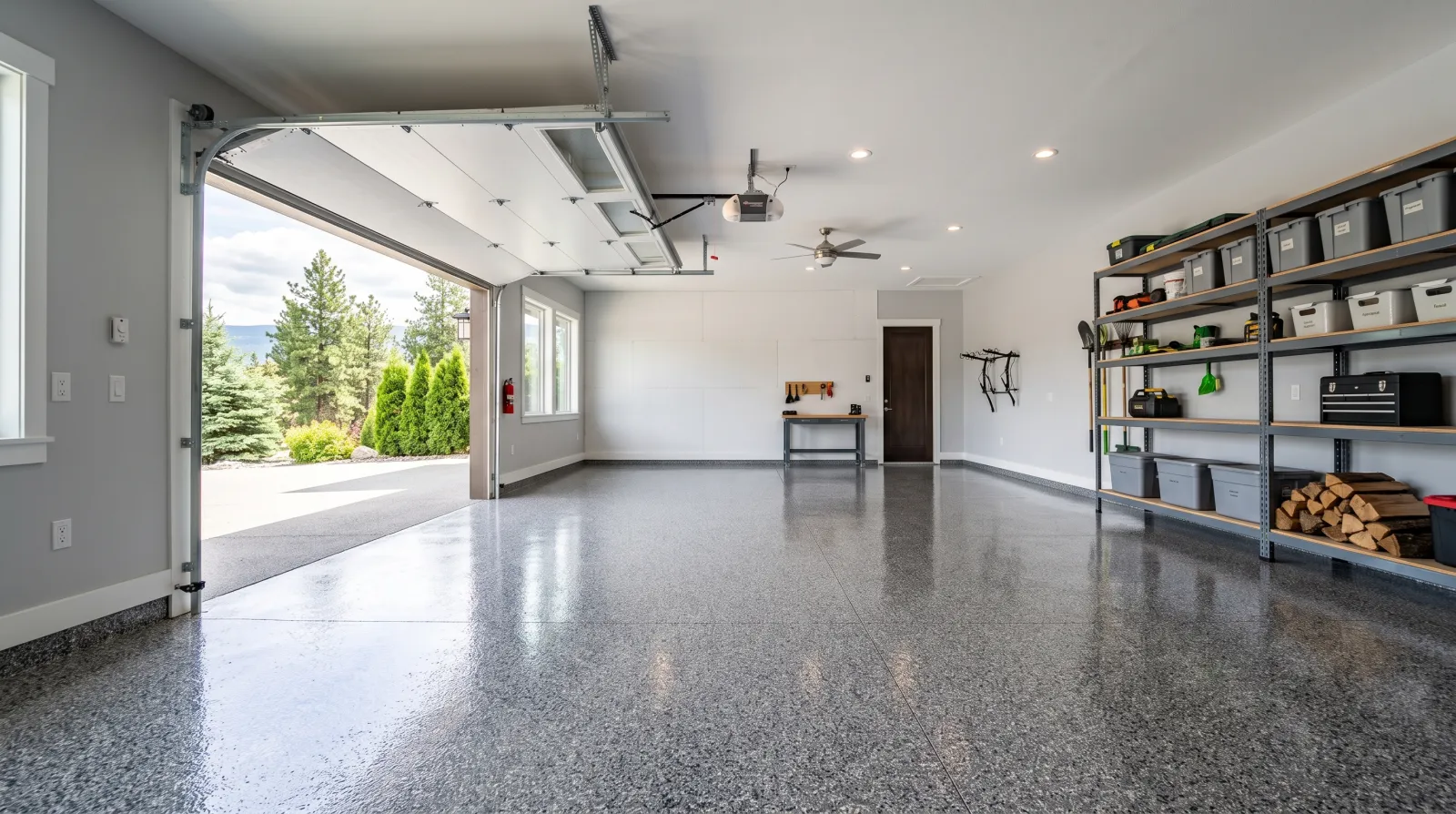
Garage & Concrete Floor CoatingsEpoxy & Polyaspartic in Kelowna
A proper floor coating turns a dusty, stained garage slab into a hard, sealed, easy-to-clean floor that handles hot tires, oil, and Okanagan winters. Epoxy, polyaspartic, flake, metallic — over diamond-ground concrete. Residential and commercial, no job minimum.
Quick Answer
A garage floor coating is a resin system — epoxy, polyaspartic, or a hybrid of both — ground into and bonded onto your concrete slab in Kelowna and across the Okanagan. It seals the surface against oil, salt, and hot-tire pickup, kills concrete dusting, and wipes clean. We diamond-grind every slab first, then quote it free on-site.
Get Your Free Quote
No obligation · Same-day response · 100% local
Diamond-Ground
Mechanical Prep, Every Slab
Epoxy + Poly
Single, Hybrid & Flake Systems
Res & Commercial
Garages, Shops & Warehouses
No Minimum
One Garage or a Whole Shop
Why Coat the Floor
A Bare Garage Slab Is Working Against You
Raw concrete looks tough, but it's porous and unprotected. In an Okanagan garage it takes a specific kind of beating — and a coating is what stops it. Here's what you're actually solving.
Hot-Tire Pickup
Warm tires pulling into the garage grab at cheap coatings and bare-slab dust, lifting little patches every time you park. A properly ground and bonded epoxy or polyaspartic floor doesn't let go — the tires roll off it clean.
Oil & Chemical Stains
Every drip of oil, brake fluid, coolant, and gas soaks straight into porous concrete and stays there. A coated floor is sealed, so spills sit on top and wipe up instead of leaving permanent dark blotches.
Concrete Dusting
Bare slabs shed a fine grey dust as they wear — it ends up on your tools, your gear, and everything stored on the floor. A coating locks the surface down so the dusting stops.
Road Salt & Freeze-Thaw
You drive Okanagan winter salt and slush right into the garage. It melts off your vehicle onto the slab, and salt plus our freeze-thaw cycles pit and scale unprotected concrete. A coating keeps that brine off the surface.
Cleaning & Wear
Rolling toolboxes, dropped wrenches, jack stands, and foot traffic grind at a raw floor. A coated surface takes the abuse and cleans up with a mop or a hose instead of endless sweeping.
The Look
A finished floor changes how the whole space reads — a flake or metallic system turns a garage into a shop you actually want to work in, or a showroom-grade commercial floor. Function first, but it looks the part too.
The Two Main Systems
Epoxy vs. Polyaspartic — Both Are Legit
There's a lot of internet noise about which one is "best." The honest answer: they do different jobs, and the strongest floors often use both. Epoxy is a proven, cost-effective base that builds thickness and bonds hard. Polyaspartic cures fast, holds its colour in UV, and takes the Okanagan's temperature swings in stride. Layer an epoxy base under a polyaspartic topcoat and you get the best of each.
| What Matters | Epoxy | Polyaspartic |
|---|---|---|
| Cure speed | Slower — walk-on ~12–24h, drive-on ~3–7 days | Fast — walk-on same day, drive-on ~24h |
| UV / colour stability | Can amber (yellow) in strong UV on its own | UV-stable, holds its colour — great topcoat |
| Temperature tolerance | Fussier about install temp & humidity | Wider install window, handles Okanagan swings |
| Longevity | Proven, durable base coat | Very hard-wearing, abrasion-resistant finish |
| Cost tier | Lower cost per square foot | Higher per foot — you pay for speed & finish |
| Best used as | The base coat / cost-effective standalone | The topcoat, or a fast full-day system |
Cure and warranty figures above are industry-typical ranges for education, not a guarantee of a specific number on your job. We confirm the exact system, cure timing, and warranty in writing on your quote.
Our Process
It Lives or Dies on the Prep
The reason DIY kits and cut-rate floors peel is almost never the product — it's the prep. We lead with diamond grinding: mechanical prep that opens the concrete so the coating bonds into it, not just onto it. No acid etching, no shortcuts.
Diamond Grind
We grind the slab with diamond tooling to strip old coatings, laitance, and contamination, and open the pores. This mechanical profile is what the coating keys into — the single biggest reason a floor lasts.
Crack & Patch Check
We flag structural cracks, spalling, and pits. Anything that needs patching gets handled before we coat — a coating is a finish, not a repair, so we sort the slab first.
Base Coat
We lay down the base — typically epoxy for build and adhesion — worked evenly across the whole floor with careful edge and corner detail.
Broadcast (Optional)
For a flake or full-chip floor, we broadcast decorative flake into the wet base, then scrape and prep it for the topcoat. Skip this for a solid-colour or metallic look.
Topcoat & Cure
A clear topcoat — often polyaspartic for speed and UV stability — locks it all in. Then it cures. We tell you exactly when it's walk-on and drive-on for your system.
Systems We Install
One Menu, Matched to the Floor
We install the full range and spec the system to how the floor gets used and how you want it to look — a home garage, a working shop, and a commercial floor are three different jobs. Residential and commercial, with no job minimum.
Epoxy
The proven, cost-effective base coat. Bonds hard to prepped concrete and builds a durable foundation — great on its own or under a polyaspartic topcoat.
Polyaspartic
The fast, UV-stable finish. Cures in hours, holds its colour, and takes abrasion and Okanagan temperature swings well. Often the topcoat, or a full one-day system.
Hybrid (Epoxy + Poly)
The best-of-both build: an epoxy base for adhesion and thickness, a polyaspartic topcoat for speed, colour stability, and wear. A popular choice for garages and shops.
Full-Flake / Chip Broadcast
Decorative vinyl flake broadcast into the base for a textured, showroom look that hides imperfections and adds grip. Popular for garages that double as a hangout.
Metallic
A pigmented metallic system that gives a marbled, high-end finish. More of a statement floor — great for showrooms, feature spaces, and standout garages.
Solid Colour
A clean, uniform single-colour floor. Simple, hard-wearing, and easy to keep clean — a straightforward upgrade for garages, shops, and commercial rooms.
Options worth asking about: we can talk through an anti-slip additive for traction and decorative flake or chip options to dial in the look. We'll go over what makes sense for your space on the assessment rather than pushing a fixed package.
Warranty & Cure Time
What to Expect After We Coat
Two questions come up on every floor: how long is it coverage, and when can I use it. Both depend on the system. Here's the honest, industry-typical picture — with your exact terms confirmed in writing on your quote.
Warranty (typical per system)
- Epoxy: installer warranties commonly run a few years up to 5, with premium builds going longer (up to 10–15).
- Polyaspartic: systems commonly carry much longer coverage, often 15-year to lifetime residential.
- Your exact OKGN warranty is confirmed in writing on your quote — never guessed off a webpage.
Cure / return-to-service (typical)
- Epoxy: walk-on in roughly 12–24 hours, drive-on in about 3–7 days once fully cured.
- Polyaspartic: often walk-on the same day (a few hours), drive-on in about 24 hours — the "one-day floor."
- We give you exact timing for your system and the conditions the day we coat.
What It Costs
Priced by the Square Foot and the System
Floor coatings are priced by the square foot and by the system you choose. A polyaspartic or hybrid build costs more per foot than a basic epoxy — but it cures fast and stands up better to Okanagan temperature swings and hot-tire pickup, so you're paying for speed and durability, not just looks.
As a planning ballpark, a typical two-car garage lands in the low-to-mid four figures, depending on the system, the prep your slab needs, and any crack or spall repairs first. We don't post a flat price because no two slabs are the same — you get a firm number after a free on-site assessment.
Want to see how the ranges work across our services? Our Kelowna cost guide breaks down concrete sealing, asphalt, and floor-coating ballparks.
What Moves the Number
Square footage
One-car, two-car, or a full shop — the biggest lever.
System
Basic epoxy vs. hybrid, flake, or metallic all price differently.
Slab condition
Old coatings, heavy staining, cracks, or spalling add prep.
Access & layout
Tight, cluttered, or awkward spaces take more time.
Ballparks for planning, not quotes. Every floor is priced after we see the slab.
Coating vs. Sealing
A Coating Is Not the Same as Concrete Sealing
Quick distinction so you get the right product: a coating (epoxy or polyaspartic) is a resin film bonded on top of a ground floor — that's this page. A penetrating concrete sealer like Pavix soaks into the slab and leaves the surface looking the same. Different products, different jobs.
Concrete sealing is our core work and where we lead — floor coatings are a real service we offer alongside it. Not sure which you want? We'll sort it out on the free assessment.
FAQ
Garage Floor Coating Questions
What's the difference between epoxy and polyaspartic floor coatings?
Both are real, proven floor coatings — they just cure and behave differently. Epoxy is a thick, proven, cost-effective base coat that bonds hard to prepped concrete. Polyaspartic cures much faster, handles UV without ambering, and shrugs off the temperature swings we get in the Okanagan. A lot of our best floors are a hybrid: an epoxy base for build and adhesion, then a polyaspartic topcoat for speed, colour stability, and wear resistance. We'll walk you through which system fits your slab and how you use the space.
How long does a garage floor coating take, and when can I drive on it?
It depends on the system. As a typical range, an epoxy floor is walk-on in roughly 12 to 24 hours and drive-on in about 3 to 7 days once it's fully cured. A polyaspartic system is the fast one — often walk-on the same day, a few hours after we finish, and drive-on in about 24 hours. We'll give you exact return-to-service timing for your job based on the system and the conditions the day we coat.
What warranty comes with a garage floor coating?
Coating warranties vary by system, and we confirm the exact term for your project in writing on your quote — no guessing off a webpage. As industry-typical context: epoxy installer warranties commonly run in the range of a few years up to 5, with premium builds going longer, while polyaspartic systems commonly carry much longer coverage, often 15-year to lifetime residential. What actually makes a floor last, more than any number, is the prep — which is why we diamond-grind every slab before a drop of product goes down.
Do you coat commercial and shop floors, or just residential garages?
Both, and there's no job minimum. We coat residential garages, and we coat commercial and industrial floors — shops, showrooms, warehouses, mechanical rooms. The system gets matched to the traffic: a home garage and a floor that takes forklifts or rolling toolboxes all day aren't the same spec. Our crews are licensed, insured, and WorkSafeBC-covered, and we schedule commercial work to keep your space usable.
Will the coating peel or turn yellow over time?
Peeling almost always comes down to bad prep — coating over a sealed, dirty, or acid-etched slab that never gave the product anything to bite into. We diamond-grind the concrete to open it up so the coating bonds mechanically, which is the single biggest reason a floor holds instead of flaking. Yellowing (ambering) is a UV thing that can show up on bare epoxy in a sunny space; a polyaspartic topcoat is UV-stable and holds its colour, which is exactly why we top a lot of floors with it.
Do you diamond-grind the concrete before coating?
Yes — every floor. Diamond grinding is mechanical prep: we grind the surface with diamond tooling to strip off old coatings, laitance, and contamination and open the concrete's pores so the coating can key in. It's the difference between a floor that lasts and a weekend DIY roll-on kit that lifts in a year. We don't acid-etch and we don't skip prep. If the slab has cracks or spalling, we flag it so it can be handled before we coat.
How much does a garage floor coating cost in Kelowna?
Floor coatings are priced by the square foot and by the system you choose. A polyaspartic or hybrid build costs more per foot than a basic epoxy but cures fast and stands up better to Okanagan temperature swings and hot-tire pickup. As a planning ballpark, a typical two-car garage usually lands in the low-to-mid four figures depending on the system, the prep your slab needs, and any repairs first. We don't post a flat price because no two slabs are the same — you get a firm number after a free on-site assessment. See our cost guide for how the ranges work.
Can you coat an old, stained, or cracked garage slab?
Usually, yes — an old slab is what diamond grinding is built for. Grinding takes the surface back to clean, sound concrete, and stains and old coatings come off in the process. Cracks and spalling are a separate thing: we flag any structural cracks or crumbling on the assessment so they can be patched before coating, because a coating is a finish, not a repair. If the slab is sound underneath, age and stains are rarely a dealbreaker.
Turn Your Slab Into a Real Floor
Garage, shop, or commercial floor — diamond-ground prep and the right epoxy or polyaspartic system, done properly so it lasts.
Free quote. No obligation. Licensed, insured & WorkSafeBC-covered.